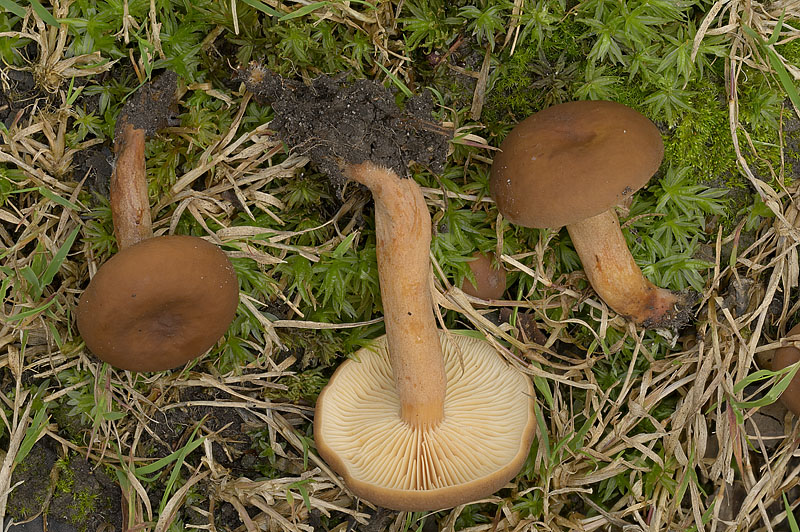
With oak. 15 September 2025 Near Lyndhurst, New Forest, Hampshire. Photograph copyright Leif Goodwin. Synonymns Lactarius subumbonatus, Lactarius cimicarius Common Name Watery milk cap Cap Convex when young, soon depressed to funnel shaped, smooth when young, radially wrinkled with age, reddish brown to brick colour, to about 85 mm across Gills Broadly adnate to short decurrent, crowded to distant, clay pink to clay buff Stem Cylindrical, narrowing towards the base, smooth, pale vinaceous when young, then cinnamon to orange brown Flesh White to pinkish-buff, firm, producing a watery whitish milk on cutting Smell Strong, sweet, pleasant, not unlike Lactarius quietus Taste Mild, then nauseous and/or acrid Season Autumn Distribution Frequent Habitat On soil in deciduous woods, usually with oak Spore Print Pale cream Microscopic Features Spores globose to broadly ellipsoidal (6.5-8.5) x (5.5-8) µm2, Q = (1.0-1.25), decorated with a network of warts and ridges about 1 µm high Edibility Inedible 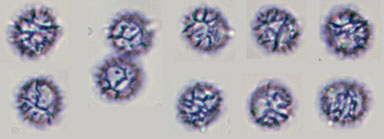
Spores in Melzer's solution viewed with a 100X immersion objective. 15 September 2025 Near Lyndhurst, New Forest, Hampshire. Photograph copyright Leif Goodwin. 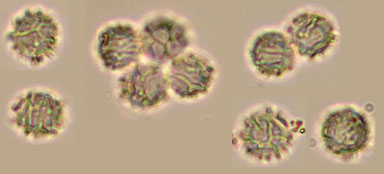
Spores in Congo Red solution viewed with a 100X immersion objective. 15 September 2025 Near Lyndhurst, New Forest, Hampshire. Photograph copyright Leif Goodwin. |